
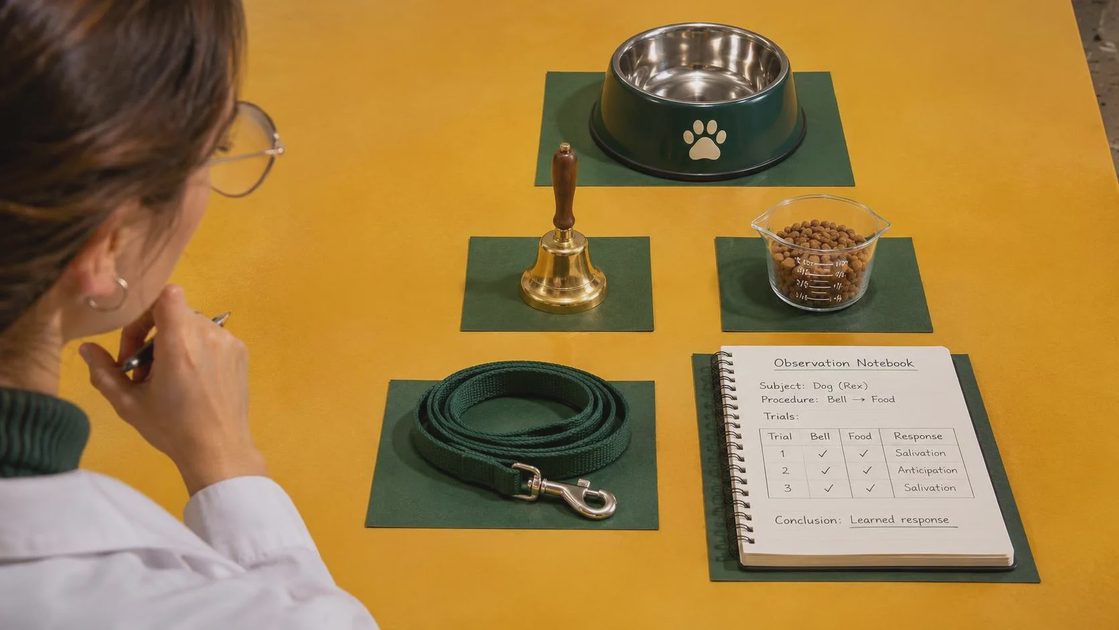
The phrase pavlov dog usually refers to an experiment showing that dogs can learn to connect a previously neutral signal with something meaningful, such as food. After repeated pairings, the signal alone can trigger a response: in this case, salivation. For an everyday owner, the useful takeaway is simple: your dog is always noticing what predicts what, whether you planned the lesson or not.
That jingle of the leash might predict a walk. A hand reaching for a collar might predict the end of play. Both associations can influence how your dog feels before you give a single cue.
What happened in the Pavlov dog experiment?
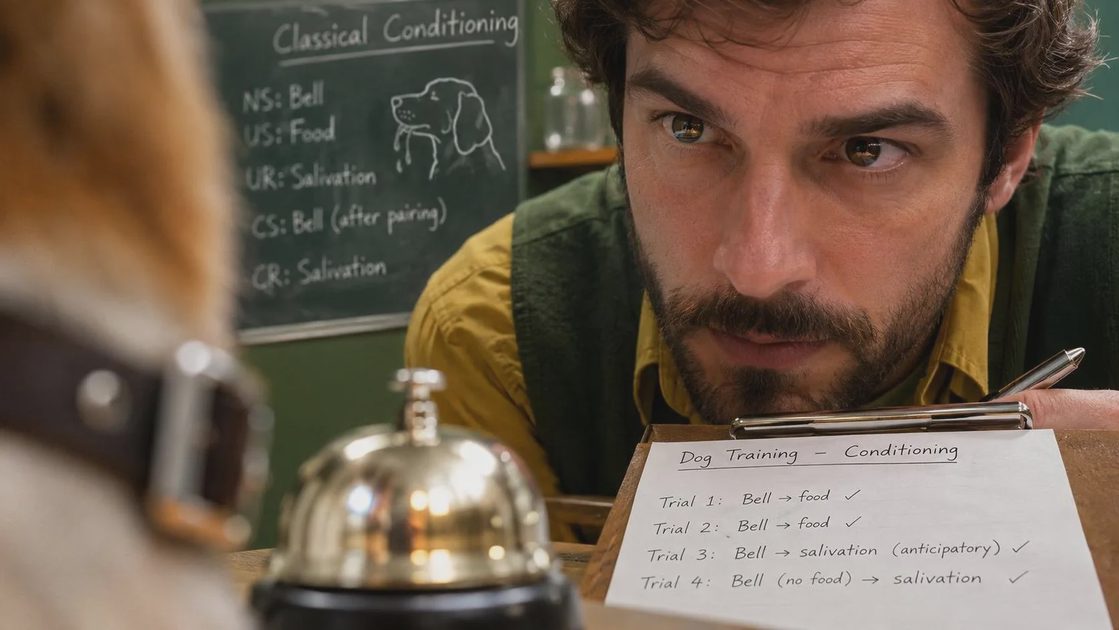
Russian physiologist Ivan Pavlov studied digestion and observed that dogs salivated not only when food arrived, but also in response to signals associated with feeding. In his experiments, a neutral signal was repeatedly presented before food. Eventually, the signal could produce salivation on its own.
This process is called classical conditioning. The food naturally produces salivation; the signal acquires meaning through its relationship with the food. Pavlov used different signals in his research, so the familiar story about one bell is a simplified version rather than the whole picture.
The dog was not deciding to drool to earn a snack. Salivation is an involuntary response. Similarly, a dog may feel excited when keys jingle or uneasy when a car pulls into the veterinary clinic parking lot. Those reactions are not evidence of stubbornness; they may reflect what those signals have come to predict.
Pavlov dog lessons you can use at home
A useful application is helping a dog feel better about a mildly worrying event. The goal is to change the association, not simply ask the dog to hold still. Trainers often call this counterconditioning when the dog already has an uncomfortable response.
Imagine your dog notices another dog across the street and is still relaxed enough to eat. When the other dog appears, offer several small, appealing treats. When the other dog is gone, the treats stop. With repetition at a manageable distance, the sight of another dog can start to predict good things.
Distance matters. If your dog is barking, lunging, frozen, or unable to take food, move farther away or use a visual barrier. Don't keep pushing closer to make the exercise harder. That was information, not failure: the situation was more intense than your dog could comfortably handle.
Choose a quiet location and keep the practice brief. A few easy encounters over several days may be more useful than one long, overwhelming outing. Some dogs need weeks or longer, and progress will not necessarily follow a straight line.
Food should follow the appearance of the trigger, not be used to lure a worried dog closer to it. Give your dog room to move away, and don't withhold meals to make treats more tempting.
Classical conditioning versus teaching a behavior
The pavlov dog story is about an association between events. Operant conditioning, by contrast, concerns the consequences of a behavior: a dog does something, and what happens next influences whether that behavior is likely to happen again.
For example, you can reward your dog for placing four paws on the floor when a visitor arrives. That is teaching an action. At the same time, if visitors consistently predict treats and enough space, your dog may also develop a more comfortable emotional association with their arrival.
The two kinds of learning often happen together. A dog who sits because sitting earns a treat may also become excited by the sound of the treat jar. You don't need to memorize the terminology to train kindly, but the distinction helps when a dog is too worried to respond to a familiar cue.
A sit is not a substitute for feeling safe. If your dog cannot settle near the visitor, add distance, use a gate, or let the dog rest in a separate room with something enjoyable. Practice greetings only when everyone has space and the dog is comfortable.
Avoid accidental associations
One practical pavlov dog lesson is that timing counts. If the nail clippers appear only when an uncomfortable trim is about to happen, your dog may start avoiding the sight of them. Instead, you can show the clippers from a distance, offer a treat, and put them away. Repeat in short sessions without trimming.
Later, if your dog remains comfortable, gradually work toward the smaller pieces of a trim: approaching a paw, briefly touching it, and eventually handling a nail. Each step may take multiple sessions. Let your dog move away, and stop or make the step easier if you see tension, avoidance, or reluctance to eat.
This is not a reason to postpone necessary care indefinitely. If nails need urgent attention or handling is already frightening, ask your veterinarian about a low-stress plan. Pain can make handling harder, so a sudden change in tolerance deserves a veterinary conversation too.
The same principle applies in the other direction. If a recall cue is regularly followed by something your dog dislikes, such as leaving the park, it can become less appealing. Sometimes call your dog, reward generously, and release them back to sniffing when it is safe. That way, coming to you does not always predict the end of fun.
When to get extra help
A pavlov dog exercise at home is not a complete treatment plan for severe fear, panic, or aggression. If your dog has bitten, is threatening to bite, cannot recover after a trigger, or is distressed during ordinary routines, start with your veterinarian. They can check for medical contributors and help you find appropriate behavior support.
Look for a qualified, reward-based trainer or veterinary behavior professional who will explain the plan and avoid punishment-based methods. Management matters while you work: use doors, gates, distance, and predictable routines to prevent situations your dog cannot yet handle safely.
For today, pick one neutral household signal, such as a word you don't already use as a cue. Say it once, then immediately offer a small treat. Repeat a few times and stop. Over several short sessions, watch whether your dog begins to look happily toward you at the word. There is no need to test it endlessly; you're simply noticing an association taking shape. Train the dog in front of you, and let their comfort set the pace.


Letters
No letters yet — be the first to write.