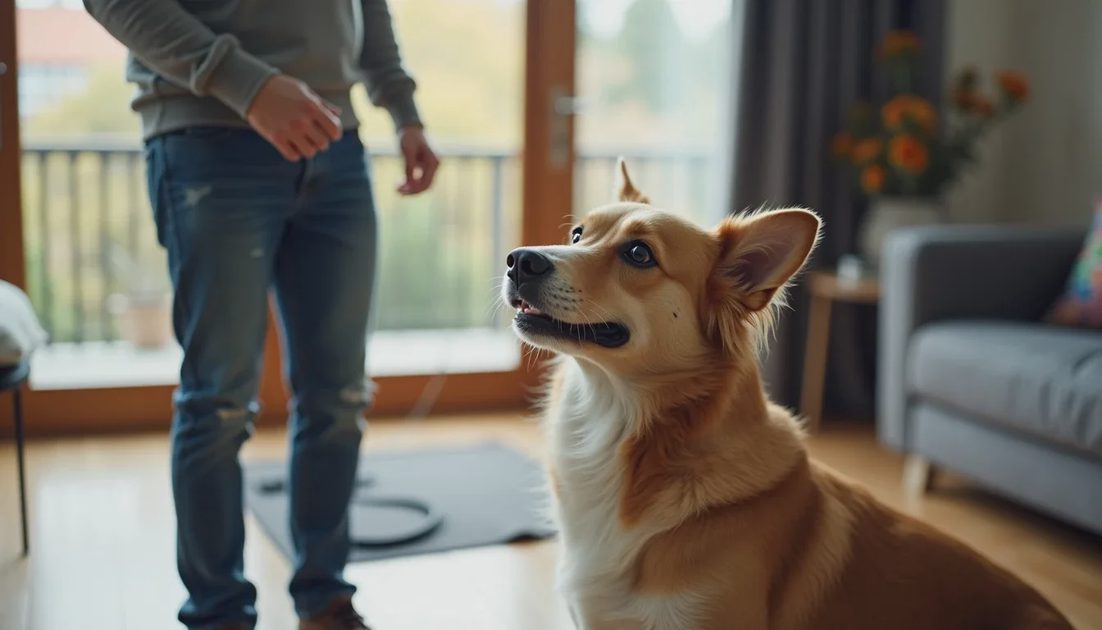
I used to give Pepper a lot of cues that made perfect sense to me and almost none to her.
“Be nice.”
“Settle down.”
“Leave it—no, really leave it.”
“Go away from the door.”
“Be good.”
She would stare at me, offer random behaviors, or simply walk off. At the time I thought she was ignoring me. Looking back, she was doing the only reasonable thing: trying to guess what an unclear request meant.
Vague cues are one of the most common sources of frustration in everyday training. They feel natural to us because we know what we intend. The dog only knows what we have actually taught and consistently reinforced. When the same word can mean five different things depending on the situation, the dog cannot form a clean association.
Why Vague Cues Fail
A cue works when it reliably predicts a specific, teachable behavior. If the cue describes a mood, an outcome, or a changing set of actions, the dog is left guessing.
Common problems include:
The cue describes an outcome rather than an action (“be calm,” “be nice”)
The cue changes meaning depending on context
The cue is used before the behavior has been properly taught
The cue is repeated until the dog eventually does something close enough
When that happens, the dog learns that the sound of the cue is only loosely related to any particular action. Over time the cue becomes background noise or a predictor of frustration rather than clear information.
The Five Vague Cues I See Most Often
1. “Settle” or “Calm down”
What we usually mean: stop pacing, stop whining, lie down and relax.
What the dog often hears: an unclear request that sometimes precedes a down, sometimes a time-out, and sometimes nothing at all.
This cue is especially common with dogs who follow their people from room to room or struggle to relax when household activity is happening. The problem is that “settle” or “calm down” describes an emotional state rather than a concrete behavior the dog can execute on cue.
Clearer alternative: Teach a specific “place” or “mat” behavior. The dog learns to go to a defined spot, lie down, and stay there. Once that behavior is solid, you can add duration and practice during normal household movement. The cue now points to a clear action instead of a vague mood.
2. “Leave it”
This cue can be excellent when taught cleanly. It becomes vague when we stretch it to cover everything—food on the counter, a dog across the street, a sock in the dog’s mouth, a person the dog wants to jump on, a smell on the sidewalk.
When one cue is asked to mean too many different responses, the dog cannot develop a reliable understanding of what is expected.
Clearer approach: Decide exactly what “leave it” will mean in your training. For most households a useful definition is: turn away from that thing and orient toward me or move with me. Teach it first with low-value items on the floor in a quiet setting. Only after the dog is solid do you carefully expand the difficulty and the types of distractions.
Other situations then get their own distinct cues (“with me,” “mat,” “sit for greeting”) so each signal stays clean.
3. “Be nice” or “Be gentle”
These phrases are often used when a dog is jumping, mouthing, or approaching another dog or person too intensely. They describe an attitude rather than a behavior the dog can perform.
A dog cannot “be nice” on cue in the same way it can sit, go to a mat, or keep four paws on the floor. The request is too abstract.
Clearer alternative: Teach and cue an incompatible behavior. “Sit” for greetings, “four paws on the floor,” or “go to your mat” give the dog something specific to do instead of the unwanted action. The dog receives clear information and a chance to succeed.
4. “Go away,” “Get back,” or “Move”
These are common at doorways, when the dog is underfoot in the kitchen, or when you need space. Without a taught behavior attached to the words, they become noise. The dog may move a step or two, then return, or simply stare.
Clearer alternative: Teach a deliberate “back up” or “to your bed/mat” behavior and put it on a consistent cue. Practice in low-distraction settings first so the dog understands the physical action before you need it in real life.
5. “No” or “Hey!” as a general interrupter
“No” can interrupt a behavior in the moment, but it does not tell the dog what to do instead. Used frequently, it often becomes background noise or a predictor that the owner is frustrated.
When “no” is the primary response to many different unwanted behaviors, the dog receives very little useful information about the preferred alternative.
Clearer alternative: Interrupt if necessary, then immediately direct the dog to a known behavior you can reinforce. The pattern becomes: stop that → do this instead → get paid. Over time the dog learns the preferred action rather than simply learning to avoid the sound of “no.”
How to Clean Up a Vague Cue
Cleaning up an unclear cue follows a consistent process:
Pick one specific behavior the cue will mean from now on.
Teach that behavior without the cue first (using a lure, capture, or shaping).
Add the cue only when the dog is offering the behavior reliably.
Practice in easy contexts before using it in real life.
Stop using the old vague version so the dog is no longer receiving mixed information.
This process feels slower at first. It produces clearer results later because the dog finally has a clean association to work with.
A Personal Example With “Leave It”
I used “leave it” for everything with Pepper. Sometimes it meant “don’t eat that,” sometimes “don’t pull toward that dog,” sometimes “don’t jump on the guest.” The cue became almost meaningless. She would freeze, offer random behaviors, or simply continue what she was doing.
I reset it completely. “Leave it” now means: turn your head away from that thing and look at me or orient toward me. I taught it with low-value items on the floor, then gradually raised the difficulty. Other situations received their own cues—“with me” for moving past distractions, “mat” for doorways and guests, “sit” for polite greetings.
Within a couple of weeks her response to the cleaned-up “leave it” was noticeably sharper. The change was not in her willingness. It was in the clarity of the information she was receiving.
What Changes When Cues Become Clear
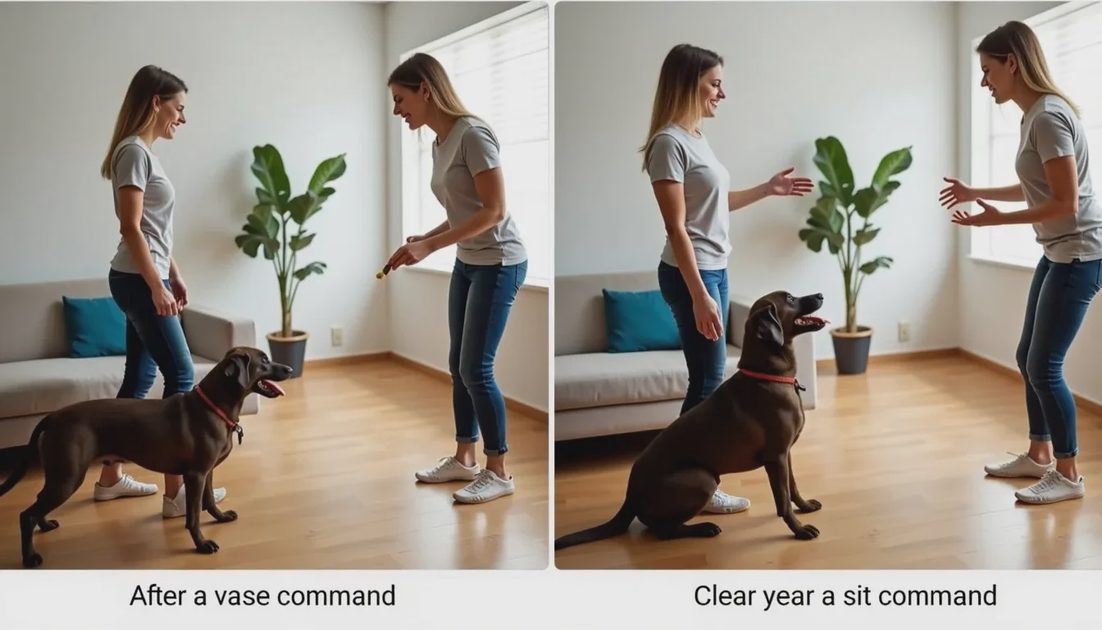
When cues are specific and consistently taught, several things improve:
The dog responds more quickly because the signal actually predicts a known behavior
You stop repeating yourself as often
Training sessions feel less like arguments and more like conversations
You can build more complex chains because each piece is reliable
Frustration drops on both sides
Clear cues do not make training effortless. They make the communication honest. The dog knows what is being asked. You know whether the dog has the information and capacity to respond in that moment.

A Practical Way to Audit Your Own Cues
Take a few days and simply notice the words you use most often with your dog. Write down the five cues you reach for when things get messy. Then ask:
Does this word point to one specific, teachable behavior?
Have I actually taught that behavior in the contexts where I use the cue?
Am I using the same word for several different outcomes?
If the answer to any of those questions is no, that cue is a candidate for cleanup. You do not have to overhaul everything at once. Pick the one that creates the most daily friction and start there.
Final Thought
Dogs are not good at reading our intentions. They are excellent at learning patterns between signals and consequences. When we give them clean, specific cues and take the time to teach the behaviors those cues should produce, communication improves for both sides.
If a cue you use regularly produces blank stares, random guesses, or delayed responses, the cue itself may be the problem—not the dog’s willingness to listen.
Train the dog in front of you. Give that dog information clear enough to act on.

Letters
No letters yet — be the first to write.