

Most training plans assume you have regular 20–30 minute blocks and a consistent schedule. Most real households do not.
Between work, errands, and ordinary fatigue, the grand training plan often collapses into occasional weekend attempts and a lot of guilt. I needed something that could survive an ordinary busy week without requiring perfect conditions.
The result was a simple 15-minute weekly structure that focuses on maintenance and small progress rather than ambitious overhauls. It is deliberately modest so it actually happens.
The Core Idea
Fifteen focused minutes, broken into short pieces across the week, can maintain known skills and slowly improve one or two targets. The plan is not a complete curriculum. It is a realistic container for consistent practice.
Ambitious plans that require perfect conditions tend to produce inconsistency and guilt. Modest plans that fit real life produce more actual repetitions. Over months, those small repetitions add up to noticeable change.
The Weekly Structure
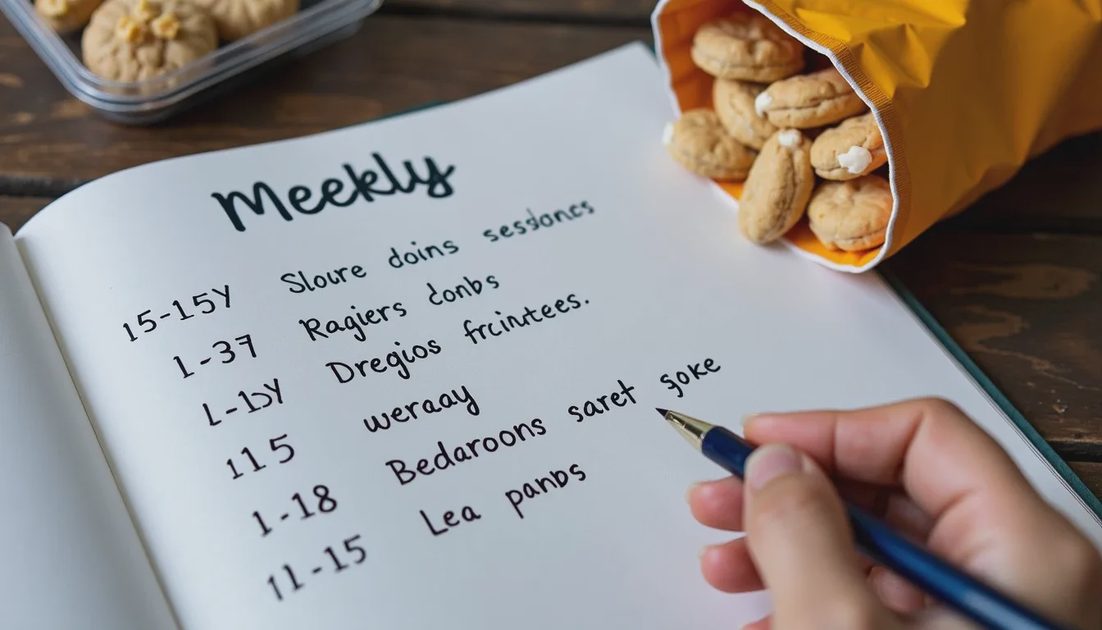
Total target: about 15 minutes of deliberate training across the week
Session length: 3–5 minutes each
Number of sessions: 3–5 short sessions
Suggested Split
2–3 sessions: Maintain known useful behaviors (sit, settle/mat, leave-it, check-in on leash)
1–2 sessions: Work on one current focus skill at an easy-to-moderate level
That is the entire framework. Everything else is optional. The plan is meant to be flexible enough that a chaotic week does not destroy it.
How to Choose What to Practice
Ask two questions at the start of the week:
Which behaviors do I need the dog to keep sharp for daily life?
Which one skill would make the biggest difference if it improved a little?
Examples of maintenance items: mat settle, polite leash walking in low distraction, coming when called in the house or yard.
Examples of focus items: longer settle duration, looser leash past mild distractions, doorbell-to-mat.
Keep the focus list to one main thing so the week does not become overloaded. Trying to improve three skills at once usually means none of them improve much.
A Sample Week
Monday (4 minutes)
Mat settle while you make coffee. Reward for staying during light movement.
Wednesday (5 minutes)
Loose-leash practice in the quietest nearby location. High rate of reinforcement for soft leash.
Friday (3 minutes)
Quick recall or hand-touch game in the house or backyard.
Sunday (3 minutes)
One short session on the current focus skill at an easy level.
Total: 15 minutes. No single day requires a big block of time. If one day is impossible, the week can still succeed with the remaining sessions.
Rules That Keep the Plan Realistic
If a day is too chaotic, skip it without guilt. The week can still succeed with three short sessions.
End every session on success, even if that means lowering criteria.
Do not add new skills until the current focus is showing clear progress.
Management (gates, leashes, baby gates) still handles the hard moments that training has not yet reached.
Short sessions are a feature, not a limitation. They protect the dog’s engagement and your own consistency.
What This Plan Is Not
It is not a promise that 15 minutes a week will solve serious behavior problems. It is a way to keep skills alive and make steady, small progress when time is limited. Dogs with significant fear, aggression, or high-intensity issues need more structured help than this framework provides.
It is also not a rigid schedule that must be followed perfectly. The value is in the consistency of short, successful practice over time, not in hitting exactly 15 minutes every single week.
Why Modest Plans Often Work Better
When a plan is too ambitious, two things usually happen. First, it gets postponed until conditions are “better.” Second, when it finally happens, the trainer tries to make up for lost time by pushing too hard. Both patterns reduce the quality of the practice and increase frustration.
A modest plan removes the pressure to wait for perfect conditions. Because the sessions are short, they fit into ordinary days. Because the goals are limited, success is easier to achieve and easier to notice.

How to Adjust When Life Gets Messier
Some weeks will be harder than others. When that happens:
Drop the focus skill and keep only maintenance sessions
Shorten sessions to two minutes if needed
Use the highest-value rewards to make the limited time count
Rely more heavily on management so the dog does not rehearse unwanted behaviors
The plan is a tool, not a test. Adjusting it to fit the week is part of using it well.
Final Thought
You do not need a perfect training schedule to make progress with the dog in front of you. You need a plan small enough that you will actually do it, repeated often enough that the dog gets clear information.
Fifteen minutes a week is not heroic. It is sustainable. And sustainable is what carries you through the messy middle.
Progress has four paws and a messy middle. Sometimes the most useful step is the one small enough to take on an ordinary Tuesday.

Letters
No letters yet — be the first to write.