

If your dog follows you from room to room, watches you while you work, and seems unable to relax unless they are within two feet of you, you are not alone.
Pepper did this for months after I adopted her. I thought I needed to teach a longer stay. What I actually needed was a clear, repeatable routine that told her, “You can relax here. Nothing is required of you right now.”
That routine became one of the most useful things I taught either of my dogs. It did not make her stop enjoying my company. It gave her a comfortable way to rest without needing constant interaction.
Why “Just Lie Down” Rarely Works
Many dogs who shadow their people are not being dominant or clingy on purpose. They are often:
Unsure what else to do
Reinforced by the attention they get for following
Lacking a practiced “off-duty” behavior
Simply telling the dog to lie down does not give them a job or a clear end to the job. A settle routine does both. It creates a defined place, a defined action, and a clear release so the dog knows when the resting period is finished.
Without that structure, “lie down” often becomes a temporary pause before the dog gets up and resumes following.
The Core Idea
We teach the dog to go to a specific spot (a mat, bed, or towel), lie down, and stay there in a relaxed state while mild household activity continues. The dog learns that this place is where good things happen and where they can turn off for a while.
It is not a perfect military stay. It is permission to rest. The goal is a dog who can relax while you move around the house, not a dog who is holding still through sheer effort.
Step-by-Step: Building the Settle Routine
Step 1: Make the mat valuable
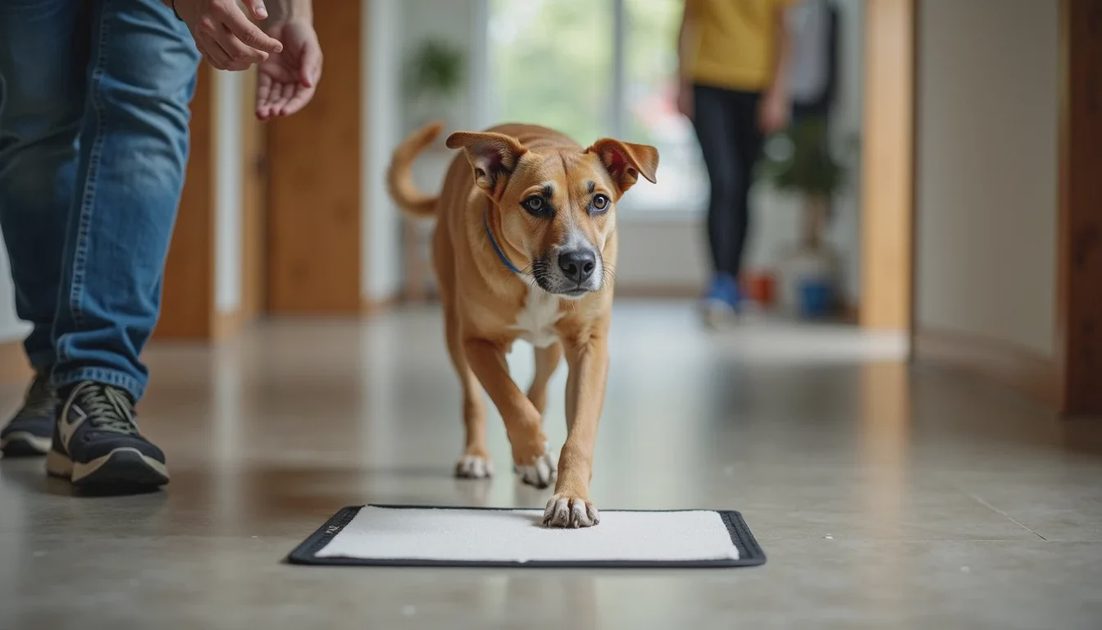
Sit near the mat. Any time the dog interacts with it—sniffs, puts a paw on it, stands on it—mark and reward. You can also scatter a few treats on the mat so the dog learns that good things appear there. At this stage you are not asking for a down yet. You are simply making the mat a worthwhile place to be.
Step 2: Add the down
Once the dog is happily going to the mat, lure or wait for a down. Reward heavily for lying down on the mat. Release after only a few seconds at first. The early goal is a clean down on the mat, not duration.
Step 3: Build short duration
Gradually increase the time the dog stays down before you reward and release. Start with 3–5 seconds and work up slowly. Use a consistent release word (“free,” “okay,” or “all done”) so the dog knows when the job is finished. End the settle before the dog ends it for you.
Step 4: Add mild movement
While the dog is on the mat, stand up, take one step, sit back down. Return and reward if the dog stayed. Slowly increase your movement—walking to the kitchen, picking up an object, sitting in a different chair. The dog learns that your movement does not automatically mean the settle is over.
Step 5: Practice in real life
Use the mat during ordinary moments: while you make coffee, answer emails, fold laundry, or watch television. Keep sessions short and successful. Real life is the eventual goal, but only after the foundation is solid.
Practical Tips That Make It Work
Choose one primary settle spot at first. Multiple locations can come later once the behavior is reliable.
If the dog gets up, calmly reset without drama. Guide them back and make the next repetition easier.
Reward calm behavior more than restless behavior. If the dog is scanning, whining, or shifting constantly, the duration is probably too long.
End the settle while the dog is still successful. Success builds confidence; repeated failure erodes it.
Use a mat or bed that is easy to move so you can practice in different rooms once the basic behavior is strong.
What to Do When the Dog Keeps Getting Up
This is normal in the early stages. Instead of repeating the cue or sounding frustrated, ask yourself:
Is the duration too long for the dog’s current ability?
Is the environment too hard right now?
Have I rewarded enough for the easier version?
Go back one step, get a few clean successes, and then build again. The goal is a dog who can relax, not a dog who is barely holding position.
Some dogs also need more physical and mental outlets before they can settle well. A short sniff walk or a bit of structured play before a settle session can help, but the settle itself still needs to be taught as a distinct skill.
How This Changed Daily Life
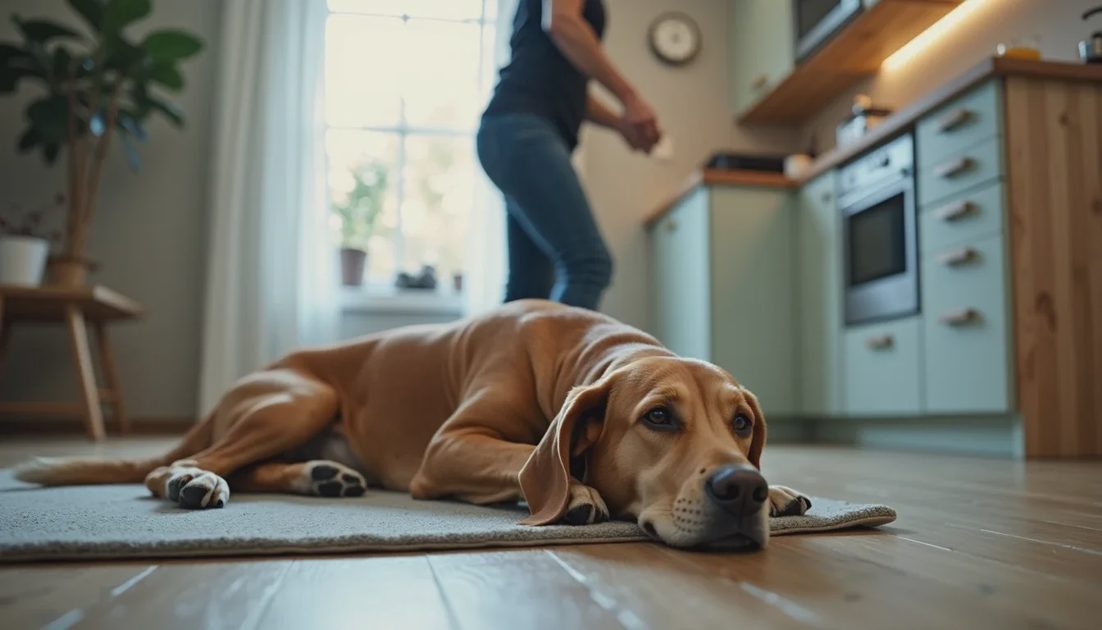
Once Pepper understood the settle routine, evenings became quieter. I could cook without a dog under my feet. I could sit down without being followed and stared at. She still chooses to be near me most of the time, but she now has a clear way to rest without needing constant interaction.
The same routine later helped with guests and doorbell situations, because she already had a practiced “go to your spot and relax” behavior. The mat became a predictable job she could do when the environment got more exciting.
Common Mistakes to Avoid
Asking for long duration before the dog understands the basic down on the mat
Practicing only when you need the behavior and never in easy, low-pressure moments
Letting the dog rehearse getting up and wandering during early practice
Using the settle cue when the dog is already over-aroused and cannot respond
Expecting the behavior to appear magically in new rooms or with guests before it has been taught there
Each of these slows progress. Short, successful sessions in easy conditions build the foundation faster than long, frustrating ones.
Final Thought
A settle routine is not about making the dog stay away from you. It is about giving the dog a comfortable off-switch so both of you can breathe. When the dog knows how to rest, following you everywhere stops being the only available job.
Train the dog in front of you. Sometimes what that dog needs most is permission—and a clear way—to do nothing.

Letters
No letters yet — be the first to write.